
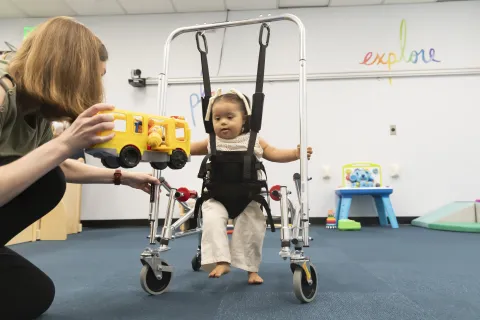
This study aims to understand how infants and toddlers with Down syndrome, aged 10 to 22 months, develop the ability to walk using mobility devices. The findings will help shape early interventions that support walking development.
Who can participate in this study?
Infants and toddlers with Down syndrome ages 10 to 22 months who cannot walk independently
Who cannot participate in this study?
Infants and toddlers with Down syndrome who are able to take 10 independent walking steps
Where does this study take place?
University of Southern California Health Sciences Campus, Los Angeles, CA (free parking or public transportation reimbursement is provided)
What activities are involved in this study?
Tests of the child's motor skills and observation of the child taking steps on a treadmill and with a mobility device
What is the expected time commitment of this study?
1-5 visits, spaced 3 months apart (number of visits depends on the age of the child at enrollment: Children who enroll in the study at 10 months of age can participate in all five visits; children who enroll in the study at 22 months will only participate in one visit)
What languages does this study support?
English and Spanish
Is compensation provided?
Yes
For more information visit the study page. If you have any questions or are interested in joining please contact: Kari Kretch at learninglab@usc.edu
IRB: UP-22-01092